Monday, July 23, 2012

from forest to forest we chug along


we've finished up work in glacier bay national park! we're headed to sitka and then out to west chichagof later in the week.

thank you, friends and family, for your good cheer and love. it's really nice to hear from you when i make it back to town. here's another new york times post, published while we were in the field. another one is coming soon... http://green.blogs.nytimes.com/2012/07/11/in-an-alaskan-archipelago-a-vision-of-past-present-and-future/

- lauren

Sarah Bisbing - On Trees, Forests, and Landscapes


As spring transitions into summer, there are certain feelings aroused in a field ecologist – those of anticipation, excitement, and fear. Anticipation for the answers we’re seeking, excitement for the many adventures that will surely arise over the course of the field season (grizzly bear charge, anyone?), and fear that we are nowhere near ready to head out and that we have absolutely no clue what we’re doing. And yet, these are the things that keep us coming back. Year after year, field season after field season. Until . . . one day, we find ourselves camped not underneath the blanket of a forest canopy but instead behind the brightly lit screen of a computer. Yes, my friends, at some point the data must be dealt with. That’s where I’m at in this whole, crazy process. And despite the lack of both fresh, mountain air and impending adventure, I come back day after day, still feeling the anticipation for answers and the fear that I have no idea what I’m doing. My own acceptance of this new role begs the question: if a field ecologist is no longer venturing out to the field each summer, does she still remain a field ecologist? Hmmm. Let’s ponder that.

As once stated by my Master’s advisor (Dr. Paul Alaback, University of Montana), the act and art of science is driven by the questions but ultimately lies in the interpretation of the data. Although we are so engrossed in the many hours, many tasks, and many challenges associated with collection of this data, the understanding and advancement of scientific knowledge actually takes place in a completely different arena. The magic happens during the process of interpretation and application. What good is all of this data if it doesn’t provide profound ecological insight (oh, don’t we all wish) or inform management and conservation?

It’s so easy to get caught up in the questions and the act of data collection. I can’t help but find forests and their associated processes incredibly interesting – so much so that I am continually coming up with new questions before answering the questions I’m already in the process of addressing (any of you also fascinated and maybe a little obsessed with the trajectory of the High Park Fire?). Geez, Sarah. This leads me (and now you, loyal reader) to where I stand in my research career: a 3rd (well, nearly 4th) year PhD candidate with four chapters worth of questions and data begging to be assessed, analyzed, and written up. Questions and data related to the how, where, and why behind species distributions. Questions and data related to the connectivity among and relatedness of populations across one of western North America’s most widespread species. Questions and data related to adaptation, plasticity, and species’ response to climatic change. How did I get here?

This madness began on a routine field day in the summer of 2009. I ventured to southeast Alaska to pursue an Army Corps of Engineers-funded research project on tree species distributions across southeast Alaska’s hydrologic gradient. I was an eager, young (okay, new, not young) PhD student with wide eyes and full of excitement for the new world I was delving into. As this eager, new student, I stood amidst the grandeur of southeast Alaska’s dramatic transition from ocean to rugged mountain peaks, amidst its (surprisingly) humbling landscape of wetland ecosystems, and amidst the spectacular forest trees this region’s climate produces. It was awesome (a word I no longer over-use or take for granted after being reminded by my PhD advisor, Dr. David Cooper, of its actual meaning). And yet, despite the splendor surrounding me, I was most captivated by the twisted, stunted, pygmy pines scattered across the peatlands of the region. On that day, I was introduced to shore pine (Pinus contorta ssp. contorta). I stood in awe of this unique, yet somehow familiar, tree. I stood, I stared, and I pondered. I’m an ecologist . . . that’s what we do. At that moment, I had no idea that this was only the beginning of my fascination with this tree.

But, alas, this encounter stuck with me throughout that first day. So, I went home, and I Google-d. Unbeknownst to me until that day, these crazy, pygmy, bog dwellers were (and still are, of course) classified as the same species I had always known to inhabit the dry, fire-prone slopes of the Rocky Mountains (lodgepole pine, ssp. latifolia). I mean, come on. Really? How can a tree that grows in dense, dog-haired stands and regenerates following catastrophic wildfire be related to a bog-dwelling, dwarf tree? But, despite my initial disbelief, turns out they are in fact classified as the same species. Furthermore, this species has two other related subspecies that grow under entirely different conditions in completely different ecological regions of western North America (Sierra lodgepole pine, ssp. murrayana, and bolander pine, ssp. bolanderi). Each subspecies actually inhabits a discrete portion of the species’ range, growing under and hypothesized to be locally adapted to a unique set of environmental and climatic conditions. At the end of that field day, I learned two incredible things that led me to where I am now. I discovered that this curious population had seemingly-unrelated associations with trees I knew well and that it was a part of an exceptionally fascinating species.

The distribution of species and the drivers of these distributions are ecological phenomena that keep me up at night. I’m not kidding. The species and the systems change, but the wondering is pervasive. It was only fitting that my chance encounter with shore pine would lead me down a path of questioning the connectivity, plasticity, and adaptive potential of this widespread species. Now, if only I could spend all of my time wandering around western North America and pondering the ecology of it all. For the time being, though, my computer and I will be spending a lot of time together.

Stayed tuned for some of my miscellaneous adventures into the forest and for a look into my final adventures in southeast Alaska. - Sarah

Sarah maintains a blog for field ecologists. Read about her work and others at http://earlycareerecologists.wordpress.com/.

Wednesday, June 13, 2012

it's go time again!

i made it here to juneau yesterday. forest-frolic blogspot got an upgrade this summer! here's the latest at the new york times: http://green.blogs.nytimes.com/2012/06/13/in-the-wild-seeking-an-answer-what-replaces-dying-trees/ -lauren

Friday, May 11, 2012

amidst old growth

so these are NOT yellow-cedars but coast redwoods (Sequoia sempervirens). most of the photographs from my past school year in california don't look like this. they document hundreds of tree cores dried and labelled, stacks of field sheets for data entry, books on stand dynamics and R coding and statistical models [i'll spare you]. i've been sorting, resorting, coding, recoding, and analyzing measurements from the thousands of trees and thousands of plants we measured last summer. we still have more to come.

(Map Source: NOAA, Office of Coast Survey)

clock is ticking again. in just six weeks we'll boat into glacier bay national park to establish sites in the live forests just north of the current limits of mortality. it is prep time: map making, waterproofing, logistics planning, trainings, checking off the list bit by bit and savoring sunshine.

- lauren

Monday, September 26, 2011

rain drops in california.


9.25.11

Today was a memorable day. It has been a month and three days since I left Southeast, and it was the first time since I left that it has rained. Granted it was a much warmer rain than what we had become accustomed to in Slocum Arm, but water is water, and I felt a wave of nostalgia rush over me as the drops sprinkled my face. It has been an interesting transition, returning back to Berkeley and starting classes again. The first week or so was spent adapting to the noises. The sound of cars, sirens, cafe chatter, my friends laughing, music, the bells of the Campanile, the sound of our broken fridge, the coffee grinder. There were sounds in Slocum too, but they were different in every way. The sound of the paddles moving though the water, a float plane overhead, the rustle of the trees, the creaking of a leaning tree, the splashing of a salmon jumping, squirrel calls, and Paul and Odin singing as they walked back to their tent. In Slocum I could let my mind wander and heard my thoughts frequently and without interruption. Now, here in Berkeley, I often find it hard to hear my own thoughts as I struggle to drown out surrounding sounds. Even as I am writing this, my housemates are watching ESPN football highlights and periodically screaming.

In addition to the increase in noises, I have also been dealing with an increase in people. I never noticed how crowded the campus and the city is. People wait in line to filter into class rooms. I swerve on my bike to avoid throngs of pedestrians. Even my house has five more people than our intimate group of four out in the woods.

This summer proved to be one of the most challenging experiences of my life. There were times, like I described in earlier posts, where my limits were undoubtedly put to the test. There were moments when I thought of how easy life in Berkeley was. But now that I have gone through that experience and learned how to live in Slocum Arm, completely immersed in a wild place, I realize that Berkeley poses just as many challenges. Suddenly I have “real life” worries, whatever that means. In the woods we were thinking about where we were going to pump our water, or how we should rig the pulley system to minimize bear infiltration. Now I am faced with turning in homework on time, answering emails, meeting with advisors, or helping ease the anxiety of friends who are trying to figure out what comes next after graduation. I have learned that no matter where I am, I will always be faced with challenges, and the ability to overcome these challenges is what keeps life interesting and engaging.

This summer has impacted my life in so many ways, some of which I may not even be aware of yet. It gave me self-confidence in my abilities, as well as humbled me in things that I needed help with. It gave me some perspective on my life and what makes me happy. It gave me strength and the will to conquer anything. Most importantly it gave me respect for Odin, Paul, and Lauren. Odin taught me to pay attention to and respect everything in the woods. He taught me the power of curiosity and the value of selflessness. I will forever be indebted to Odin for the hours he would spend picking blue berries just so we could have something fresh and sweet to put in our morning oatmeal. Paul taught me what it means to work hard and stay positive. I don’t think I heard Paul complain once, and when I was crawling into the tent after a hard and long day, Paul was staying up to sew the end of the tape measure back on so that our measurements would be exact. When I was in “pout town” because it had been raining for two days straight and we were still in a plot at 7 at night, Paul was seemingly unaffected, telling jokes and taking DBH measurements as if it were a warm summer day. Lauren taught me persistence and an unwavering will to succeed. If I thought my summer had challenges, Lauren had ten times the challenge. Lauren not only deserves respect for accomplishing such a physically and emotionally taxing project, but she also put together a dream team of people. Although we all had our differences, one thing we shared was a determination to get the job done, and get it done well. I truly am honored to have spent my summer with these amazing people, and there are many things that I miss about our time together on the outer coast.

I guess to wrap up this sentimental blog post I would like to thank everyone that helped with the project, we really couldn’t have done it without you and would probably still be out in Slocum on a weather hold with nothing but Mountain House dinners left to eat. I will remember this experience for the rest of my life, and I can already feel an itch to return to the wild and beautiful outer coast.

-kate

Friday, August 26, 2011

in the belly


8.23.11 I crawled into my sleeping bag here on the rooftop of the ferry at 4:30am this morning after loading all our gear together one last time. Kate left by plane last night. We all took her together, “family style.” Odin was supposed to leave two days ago, but the fast ferry is in for repair. Paul and I got delayed too. I have been aching, aching, aching, to get to Juneau, to stop tackling checklists and logistics and be with community and friends again. Time is too short. I have to leave Alaska all together in just two days. I just want to pause and be here with people I miss.

The broken ferry was ironic to say the least. I was thinking we made it through summer by foot, kayak, float plane and boat in the big swells all clear. Then there we were stranded again by the most reliable form of local transportation – the monster ship. In Sitka we cruised around town in Charlie’s rig these last few days. In the spirit of small town Alaska, he tossed me the keys to his ancient truck after we hit the docks at Ceiling Cove on our last trip out. Said he’d be going out of town and we could probably put that thing to use. Unreliable breaks and a gas guzzling rusted beauty of a ride. Loved that beast. Kind of the perfect end to our summer.

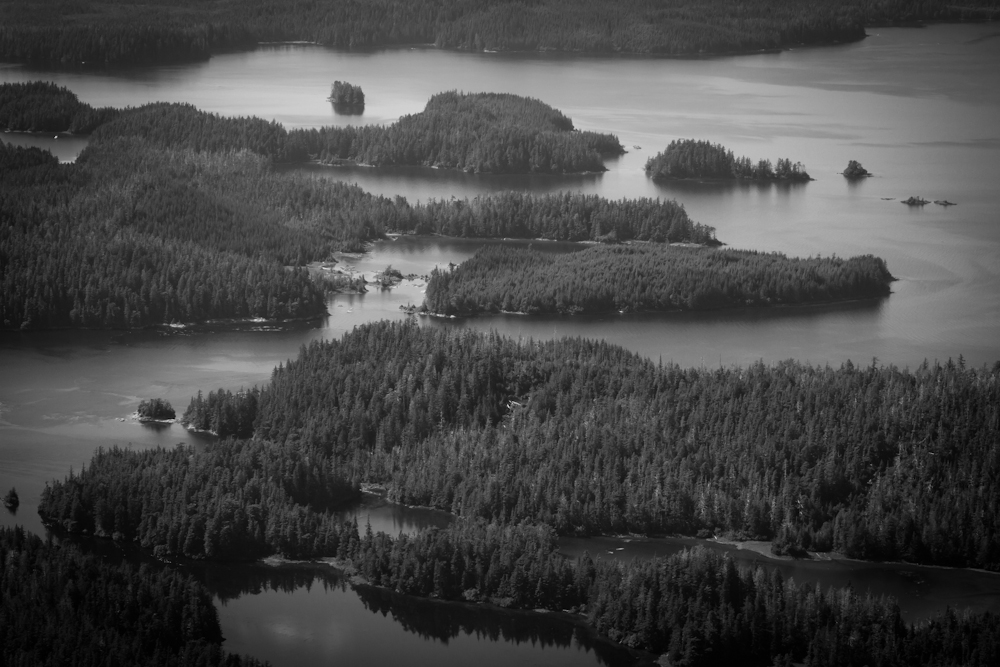
I slept hard on the ferry, woke up to the cold air on my face and the grey light glowing, that thing that happens only here in Southeast, and I still don’t know how to describe. One kind of just has to experience it. I miss it already. Layers of cloud blanket the forested islands as we move through the passage. I realize that I’m looking at a the same route I’ve traveled before differently now. I know what it feels like to be deep in those forests. I can imagine what life they hold. As I peeled back the cocoon of my sleeping bag to unveil the solarium view through sleepy eyes, I remembered a story that a dear friend and mentor sent me when she saw some photographs from our summer. Years back, she was working on a book in the American West and venturing into open landscapes there, and she spent an day visiting with a Zuni. After sharing stories of place, he put his hand upon her stomach and told her “You are in the belly of the earth. ” She told said the same for our summer.

I’ve been in the belly, and I’m watching in fade into the distance before me now through sleep eyes.

The grey shifts to white then it all disappears at the horizon. I’m afraid of what I might forget.

The boat’s engine is purring. My body is still warm in depths of my bag. There’s a slow vibration around me and the gentle feeling of moving forward bit by bit. Raindrops are falling on the deck, splattering. The American flag is flapping in the wind on the stern. Its stripes provide the only color breaking the blue and grey in 360 degrees. I can almost make out the sound of it snapping back and forth above the ferry’s hum. I’m thinking about the belly. I suppose it’s what this is all about – being in the belly of wilderness, figuring out how it’s changing, and what that can teach us. I have a lot to sort out, but this has been a start.

The compass points north, but I'm headed home now. -Lauren

Saturday, August 20, 2011

bull kelp passage & wood burning stoves


August 18, 2011. Last night we sat on the rocky beach here at Klag Bay with the tide approaching at our feet. We smoked cigars and drank whisky like old weathered seafarers in the salty mist and watched salmon leap. We reveled in the sweet celebration of a mission complete on full bellies of fresh salmon Paul caught in the Whale. 40 plots finished, thousands of trees and saplings measured, no one attacked by bear, impaled by spruce limb, eaten by root holes nor capsized in kayak. I tend to prepare for the worst but always strive for the best, and that makes the best stuff that much better when things actually work out. I will long remember how it felt to sit together there by the water, a mirror of memories of the forests that tower. We have been through a lot together in these 9 weeks. It has been an experience of a lifetime for us all.


I’ve started to list the things I will remember most about each trip and each base camp. I try to scrawl the notes at night before my eyes shut all too quickly as soon as I’m horizontal. The notes are just spatterings of moments and memories I’ll expand into the book I want to write. At Klag, I treasure silence. The quiet, broken by sounds I won’t hear again for a long while and never again in this way. The crackling of a fire. The wisp of eagle wings above the canopy. Odin’s big feet upon the cabin floor. The scratching of branches on my coat as I move through the forest. Boots slogging in muskeg. Surfacing sea lions. Kayaks touching barnacles. The crack of the compass case as I check my bearing. Rain upon rocks and sea. The sound of water poured into a tea kettle. The heavy breath of my friends as we stand together under a tarp in the cold. Endless chatter of squirrels and the songs of kinglets. These are sounds lost in “the real world.” Soon I’ll hold conversations while cars whiz by and subways screech. I’ll talk over twenty different voices in a café or holler over music at a concert. I may not hear the coffee fill my cup. The background noise of a city will be louder than any central one I have noted here all summer. I am going to miss simple sounds. Here at Klag, I want to hold onto the echo of bull kelp crawling with the tide.


Trip 4: Klag Bay. The cabin with deep history. “Vacation week” in comparison. A wood burning stove. Wet polypro and wool drying by clothesline. 4 pairs of extratuffs puddled together. The sweet smell of yellow cedar burning. The way the bunkbeds squeek as we crawl in and out. Odin’s eight egg flip at 6:30am. The excitement in his eyes to cook on an oven after all these weeks. Snacks, endless snacks from carepackages in Sitka. Creek girgling outside. Steam rising from coffee mugs. We watch rain fall through glass. A strange, unfamiliar divide between inside and outside. The way the light shines in from the window facing south. Oddly enough, reading Cadillac Desert on the plywood floor. Paul’s first salmon. YAhoooo from the distance. Sauna night. Cold bodies in fresh water. Bucks upon beaches. Dense canopies and all live cedar forests. The “savannah” hike – shore pine muskeg and 360 degrees of open bog. Our hardest pummeling by rain. Last plot, most trees we’ve seen in one spot ever. Western hemlock and yellow cedar, oak ferns and cedar seedlings. Paddling through the passage, morning and night. The clunk of the kayak rutter upon slithering snakes of seaweed. The way Odin and Paul evenly divide the tasks of Plot 40, as if to admit no one quite wanted it to end. Last quadrat. Last big tree. Last canopy photograph. Last tree core.


On other pages of my journal I have kept notes for methods, excerpts from the study I’ll use to share my science. We’ve kept a log of “Wilderness Character” together thoughout the summer. We log planes that fly above or trash we find or any signs at all of human activity our here. It’s an effort part of a national initiative to monitor our Wilderness lands and how they have evolved since our country put these places aside when the Wilderness Act passed. Alongside science and field notes of plots, distances we’ve hiked, and charts of all the locations where climate sensors will collect data for the next year, I’ve also started to think about life on the other side. What home is. Where I go next. What that will be like.

I made a list of things I want to do, or create, and things I hope for on the other side of the outer coast. Rereading it makes me realize what matters beyond my life here and this project. Outside the occasional daydream of cotton, I don’t really long for any material possessions. My list is quite short – simple pleasures like hot baths, community and friends, talking more with family, surfing, feeling the sun and ocean on my body, fresh greens from the farmers market, more hugs, slow Sunday mornings in warm bed. And then finding a way to share this experience and what I’m learning out here. I’ve thought a lot about a sense of place. As much everything on the outer coast has demanded our full attention, this past trip has also been a bit of a transition for us all. Over dinner at night, we have slipped in and out of talking about the day, to thoughts of the future. Kate says, “I cannot imagine that in 6 days I’ll be in a classroom in Berkeley.” I wonder what it will be like for me to be processing all we’ve collected this summer outside of Alaska. As much as I stay present during the days, I’ve toyed with thoughts of moving to the ocean in California, coming back this winter to Sitka or Juneau, and visiting friends in Montana in the fall. I don’t know what comes next. For the first time in a long while, I can’t seem to plan. I’ve resolved just to let things unfold as they should.


I do know that tomorrow Charlie comes back for us. We’ll pack up our things and boat back together to Sitka, towing with us the kayaks we brought out here 9 weeks ago. We’ll clean gear and drink beers, pack up tree cores for shipment and copy data sheets. Soon I’ll be loading 500 lbs of stuff on the ferry back to Juneau. I’ll have a few days to visit with friends there. Before I know it, I’ll be on a plane, a jet this time, with hundreds of other people and a roaring engine. And then I’ll be boxing up rubber pants and pulling out sundresses and trying to make sense of history, of wilderness, and of change from tattered Write-In-The-Rain paper, photographs, and deep memory.

But today, I’ll sit here at Klag and watch the tide come and go. It’s glory day again, my last one this summer season. - Lauren